USA 21st Century Artemis Lunar Program Accelerates via Infrastructure Contracts, Information Gathering
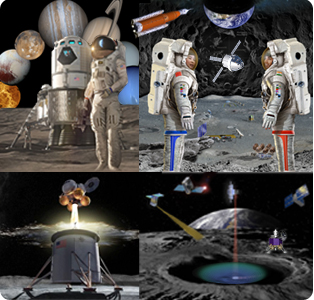
Artemis program, which emerged from Space Policy Directive 1, seeks to realize sustained lunar human presence and Moon South Pole exploration with additional commercial and international partnerships. The Human Landing System contracts to Blue Origin US$579M, Dynetics $253M and SpaceX $135M for Artemis mission 3 could see the first woman and next man on the Moon in 2024. The US$250M Volatiles Investigating Polar Exploration Rover 2023 will be delivered through TBD Commercial Lunar Payload Services (CLPS) contractors to investigate South Pole permanently shadowed craters. Of the 14 chosen CLPS providers, awarded has been Astrobotic $79.5M Peregrine lander launching July 2021, Intuitive Machines $77M Nova-C launching Oct 2021, and Masten $79.5M XL-1 for South Pole landing late 2022. Other potential bidders for future missions are Blue Origin, Ceres Robotics, Deep Space Systems, Draper Laboratory, Firefly Aerospace, Lockheed Martin, Moon Express, Orbit Beyond, Sierra Nevada Corporation, SpaceX and Tyvak. International lunar gateway will be scaled down / postponed to achieve lunar landings asap. Payloads and Research Investigations on the Surface of the Moon (PRISM) RFI remains open until May 10 to generate mission ideas. Artemis 1 launching April 2021 on Orion via SLS for 25.5-day mission will host multiple payloads aboard, and deploy 13 international lunar CubeSats including Lunar Flashlight, Lunar Polar Hydrogen Mapper and Lunar IceCube. Four-person Artemis 2 in 2022 should be the first crewed flight to the Moon since 1972. (Image Credits: NASA, JPL, Caltech, ILOA, SPC, Canadensys, Boeing, Lockheed Martin) |
MONDAY Highlights…
|
 May 4 —
  May 4 — NewSpace: First people launching to space from American soil since 2011 preparing for end of month
  May 4 — USA:
 = All times
for terrestrial events in local time unless noted.
 = All times for international terrestrial events in local time unless noted.
 = All times for space events, and…
 = All times for international space / astro events in Hawaii Standard Time unless noted. Add 10 hours to obtain UT (‘Universal Time’).
Weekly Planet Watch – Evening Planets: Venus (W), Uranus (W); Morning Planets: Mercury (E), Mars (SE), Jupiter (SE), Saturn (SE).
United Arab Emirates Joins Spacefaring Powers In Multifaceted Exploration Strategy
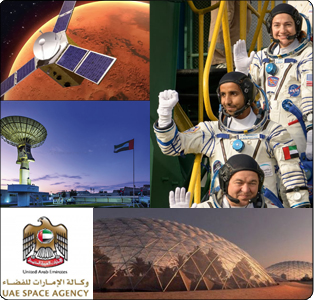
UAE is widely known for terrestrial feats such as construction of tallest structure on Earth, 829.8-m Burj Khalifa, but increasing attention centers on ambitious off-world goals of United Arab Emirates Space Agency (UAESA). Funded US$383B per Euroconsult Government Space Program expenditure report in 2019, UAESA is the only formal space agency in the region. First UAE astronaut Hazzaa Al-Mansoori completed 8-day spaceflight participant mission to ISS in Sept of 2019, and a class of 10 future Mohammed Bin Rashid Space Centre (MBRSC) Astronaut candidates currently train outside Moscow at Scientific International Research in Unique Terrestrial Station, a closed biosphere habitat, as part of UAE Analog Mission #1. After 83-hour transfer, 1,500-kg Hope Mars Mission probe prepares for launch on Mitsubishi Heavy Industries H-IIA at Tanegashima Space Center, Japan, racing to join USA Perseverance and PR China Huoxing-1 in achieving July launch window. Program objectives envision self-sustaining community on Mars by 2117. Landing in 2021 may coincide with 50th commemoration of Emirati independence from the United Kingdom, 1971, celebrated throughout the Federated City-States of Dubai, Sharjah, Ajman, Fujairah, Ras al-Khaimah, Umm al-Qaiwain and capital Abu Dhabi. Within popular culture, UAE space dramatization television series Majarat debuts. Dubai will be host of International Astronautical Federation annual congress in 2021, postponed from 2020. Both MBRSC and UAESA are recipients of the IAF 3G ‘Geography / Generation / Gender’ award. (Image Credits: NASA, UAESA, MBRSC, Dubai Media Office) |
May 4-6 — California Polytechnic University, San Luis Obispo CA: CubeSat Developers Workshop 2020; at Cal Poly Performing Arts Center; postponed.
Continued from…
TUESDAY
|
May 5 — Moon: 6.7° NNE of Spica, 13:00; at perigee (distance 359,663 km), 16:56.
May 5 — Eta Aquarids Meteor Shower Peak: The 1st of 2 annual showers that occur as Earth passes through Halley’s Comet dust; Eta Aquarid meteors appear to radiate from Constellation Aquarius, offers 50+ per hour, peak 03:00.
May 5 — Aten Asteroid 2020 HR8: Near-Earth Flyby (0.023 AU)
May 5 — Apollo Asteroid 2020 HF7: Near-Earth Flyby (0.024 AU)
May 5 — Apollo Asteroid 2020 HZ6: Near-Earth Flyby (0.026 AU)
May 5 — Apollo Asteroid 2020 HL: Near-Earth Flyby (0.043 AU)
WEDNESDAY
NET May 6 — Roscosmos State Corporation, Launch Proton / Express 80 & Express 103, Baikonur Cosmodrome, Kazakhstan: Proton Rocket set to deliver Express 80 and Express 103 communications satellites for Russian Satellite Communication Company.
May 6 — Apollo Asteroid 2020 HL6: Near-Earth Flyby (0.005 AU)
THURSDAY
May 7 — SpaceX, Launch Falcon 9 / Starlink 7, SLC-40, Cape Canaveral AFS FL: SpaceX rocket to launch 8th batch of ~60 satellites for Starlink broadband network.
May 7 — JPL, Caltech, NASA, Online / Pasadena CA: von Kármán Lecture Series 2020: Becoming a NASA Engineer; by Tracy Drain of JPL, 19:00 PDT.
May 7 — The National Academies, Online / Washington DC: Writing White Papers for the Decadal Survey on Planetary Science and Astrobiology: Webinar for Early Career Professionals; featuring Phil Christensen of Arizona State University, 13:30-15:30 EDT.
May 7 — Cornell University, Ithaca NY: Colloquia: The Fractured Moon – Understanding the Evolution of Porosity and History of Impacts on the Moon; by Jason Soderblom from MIT, cancelled.
May 7 — Moon: Full / Super / Flower Moon, 00:44.
May 7 — Eta Lyrid Meteor Shower Peak: Shower offers about 3 per hour, peak 17:00, unfavorable viewing due to Full Moon.
May 7 — Apollo Asteroid 2020 HL6: Near-Earth Flyby (0.011 AU)
May 7 — Apollo Asteroid 438908 (2009 XO): Near-Earth Flyby (0.023 AU)
May 7 — Apollo Asteroid 2020 HM4: Near-Earth Flyby (0.028 AU)
FRIDAY
May 8-9 — Space Generation Advisory Council, Madrid, Spain: 5th European Space Generation Workshop: Space for Earth and Humanity; postponed to October 30-31.
May 8 — Apollo Asteroid 2020 HB6: Near-Earth Flyby (0.025 AU)
SATURDAY
May 9 — Moon: 6.3° NNE of Antares, 15:00.
May 9 — Mercury: At perihelion, 0.3075 AU from Sun, 18:00.
May 9 — Apollo Asteroid 2020 HC6: Near-Earth Flyby (0.007 AU)
SUNDAY
May 10 — NASA, Online / Washington DC: Due: Request for Information – Payloads and Research Investigations on the Surface of the Moon (PRISM).
May 10 — Apollo Asteroid 388945 (2008 TZ3): Near-Earth Flyby (0.019 AU)