Mars Approach Phase Nears for International Earth Fleet of Exploratory Probes En Route
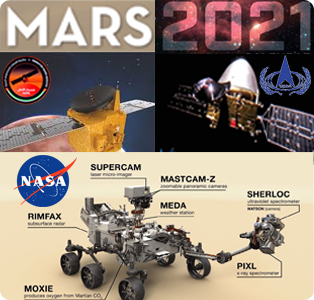
UAE, China and USA spacecraft are traversing nearly 500M km to Mars: UAESA Hope orbiter, launched by JAXA and designed by Mohammed bin Rashid Space Centre in collaboration with USA Universities, leads the convoy. Hope is expected to reach Mars Orbital Insertion February 9 following 4th Trajectory Correction Maneuver (TCM) December 29 and subsequent braking, lowering velocity from ~121,000 – 18,000 km/h, eventually maintaining a highly elliptical (1,000 km x 49,380 km) Scientific Orbit. CNSA Tianwen-1 is the second attempt at Mars for China, having lost Yinghuo-1 aboard the failed Roscosmos Fobos-Grunt in 2011. Although Tianwen-1 is entirely domestically engineered and produced, CNSA has not eschewed cooperation: ESA Mars Express orbiter will provide data relay redundancy while ground stations in Kourou, French Guiana and Las Lajas, Argentina will support communication alongside Chinese Deep Space Network stations in Kashi and Jiamusi. Tianwen-1 is to reach Mars orbit in Feb, landing on Utopia Planitia (110.318°E, 24.748°N) April 23. NASA Perseverance rover and Ingenuity helicopter to undergo 3rd TCM Dec 18, with 45-day EDL phase starting Jan 4 in preparation of Feb 18 Jezero Crater landing. Assuming mission success, UAE will become the 5th nation to reach orbit, China will become the 3rd nation to land, and USA will further solidify its status as world leader in Martian exploration, with Perseverance / Ingenuity joining Insight and Curiosity on the surface with Odyssey, Reconnaissance and MAVEN maintaining orbit. (Pictured: TW-1 Deployable Camera images Tianwen-1 from space; Image Credits: NASA, CNSA, UAESA) |
MONDAY Highlights…
|
 Dec 14 —
  Dec 14 — NewSpace:
  Dec 14 — USA: First woman and next man to walk on Moon among 18-member
 = All times
for terrestrial events in local time unless noted.
 = All times for international terrestrial events in local time unless noted.
 = All times for space events, and…
 = All times for international space / astro events in Hawaii Standard Time unless noted. Add 10 hours to obtain UT (‘Universal Time’).
Weekly Planet Watch – Evening Planets: Mars (S), Jupiter (SW), Saturn (SW), Uranus (SE), Neptune (SW); Morning Planets: Venus (SE).
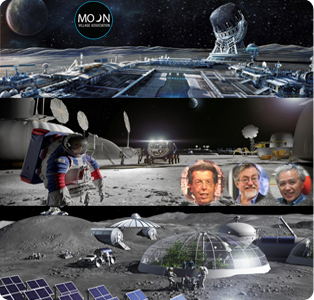
MVA Hosts Architecture Workshop, Looks Toward Near-Term Missions & 2045 Permanent Moon Base |
Dec 14 — Chang’e-3 Lander, Guang Han Gong, Sinus Iridum / Mare Imbrium, 44.12°N 19.51°W, Moon Surface: Spacecraft reaches 7 full years on Moon surface, landed 2013.
Continued From…
|
TUESDAY
NET Dec 15-16 — Chang’e-5 Return to Earth, Siziwang Banner, Inner Mongolia: CE-5 sample return with up to 2 kg of lunar regolith from Moon Mons Rümker Region planning to land.
Dec 15 — SpaceBase, Orbital Astronautics, Online / Christchurch, New Zealand: Applications Due for Competitions: Orbital Student and Orbital Startup; for students and entrepreneurs globally to compete to launch flight ready payloads to space in 2021.
Dec 15 — The National Academies of Sciences, Engineering, Medicine, Online / Washington DC: Planetary Science and Astrobiology Decadal Survey 2023-2032: Panel on Mars Meeting #5.
Dec 15 — LPI, USRA, NASA, Online / Houston TX: Abstract Due / Lunar Surface Science Workshop: Space Biology; being held Jan 20-21, 2021.
Dec 15 — Moon Village Association, Online / Vienna, Austria: Applications Due: Project Manager position for the First MVA Payload Project.
Dec 15 — Iridium Communications, Online / McLean VA: Virtual Press Conference; to share a historic satellite and maritime industry announcement, 09:00 EST.
Dec 15 — Mercury: At aphelion, 0.4667 AU from Sun, 17:00.
Dec 15 — Coma Berenices Meteor Shower Peak: Appearing to radiate from constellation Coma Berenices, shower can produce 3 meteors per hour, 03:00.
Dec 15 — Apollo Asteroid 2018 XU3: Near Earth Flyby (0.043 AU)
WEDNESDAY
Dec 16 — ISS, NG Cygnus CRS-14 Release, LEO: Northrop Grumman Cygnus freighter dubbed S.S. Kalpana Chawla to be released from ISS 10:15 EST with waste for re-entry disintegration in Earth atmosphere, live coverage available; NASA Glenn SAFFIRE V experiment to be conducted to examine fire growth in the range of pressures and oxygen concentrations.
Dec 16 — SETI Institute, Online / Mountain View CA: Lecture: A Rainbow of Exoplanets; by Angelle Tanner – Associate Professor at Mississippi State University, Ivan Paulino-Lima – research scientist at Blue Marble Space Institute of Science, moderated by Franck Marchis of SETI, 19:00 PST.
Dec 16 — NASA, Online / Washington DC: Proposals Due for CubeSat Launch Initiative.
Dec 16 — British Interplanetary Society, Online / Crowdcast, United Kingdom: Lecture: Exploring Mars with Ground Penetrating Radar; by Nathaniel (Than) Putzig, Senior Scientist at Planetary Science Institute.
Dec 16 — AIAA SF Section, Online / San Francisco CA: Young Professionals Virtual Happy Hour; with a talk on robotics and automation by Chestley Couch from Clemson University, 17:00 PST.
Dec 16 — Moon: 2.90° S of Jupiter, 20:00; with Jupiter and Saturn within circle of diameter 3.03°, 20:00; 3.0° SE of Saturn, 21:00.
Dec 16 — Apollo Asteroid 2020 VY1: Near Earth Flyby (0.034 AU)
THURSDAY
Dec 17 — ISRO, Launch PSLV / CMS 1, Satish Dhawan Space Center, Sriharikota, India: Polar Satellite Launch Vehicle designated PSLV-C50 to launch CMS 1 communications satellite.
Dec 17 — Roscosmos State Corporation, Launch Soyuz / OneWeb 4, Vostochny Cosmodrome, Russia: Soyuz rocket to launch 36 satellites into orbit for OneWeb constellation.
Dec 17 — SpaceX, Launch Falcon 9 / NROL-108, SLC-40, Cape Canaveral AFS: SpaceX Falcon 9 rocket to launch classified spacecraft payload for U.S. National Reconnaissance Office.
Dec 17 — TechCrunch, The Aerospace Corporation, Online / Los Angeles CA: TC Sessions: Space 2020.
Dec 17 — JPL, NASA, Caltech, Online / Pasadena CA: Submissions Due: NASA Artemis Moon Pod Essay Contest; for USA students in grades K-12 to imagine what it would be like to live with a pod of astronauts on the Moon.
Dec 17 — Stanford School of Humanities and Sciences, Chemical Engineering, Continuing Studies, Office of the Dean, School of Medicine, Online / Stanford CA: Zoom Seminar: An Interdisciplinary Evening of Astronomy, Conceptual Art and Cinema; with Daniela de Paulis (Artist in Residence at the Dwingeloo radio telescope, Netherlands) on her conceptual art inspired by space exploration and SETI, and Janine Marchessault (Professor at York University).
FRIDAY
Dec 18 — STEAMSPACE, Online / Austin TX: Registration Due: 6th Annual Cities in Space Student Conference & Competition; being held Feb 5.
SATURDAY
Dec 19 — Gaia, Sun-Earth L2 Lagrange Point: ESA spacecraft reaches 7 full years / enters 8th year in space today; now in extended mission phase working to map more than 1 billion stars; launched in 2013.
Dec 19 — Virgin Orbit, LauncherOne / ELaNa-20, Mojave Air and Space Port CA: Launch window opens today 10:00-14:00 PST for VO to attempt Demo 2 mission of LauncherOne (dropping from modified Boeing 747 carrier jet Cosmic Girl) carrying 10 Cubesats under NASA Educational Launch of NanoSatellites (ELaNa) program.
Dec 19 — AIAA, Online / Los Angeles CA, Los Vegas NV: A Space Architecture Gathering with AIAA Los Angeles – Las Vegas Section; 10:00-14:00 PST.
Dec 19-20 — Indian Association for General Relativity and Gravitation, Online / Gandhinagar, India: 31st Meeting of the Indian Association for General Relativity and Gravitation (IAGRG).
Dec 19 — Mercury: At superior conjunction with Sun, 17:00.
Dec 19 — December Leonis Minorid Meteor Shower Peak: Appearing to radiate from constellation Leo Minor, shower can produce 5 meteors per hour, 01:00.
SUNDAY
Dec 20 — Mars 2020 Perseverance Rover Trajectory Correction Maneuver #3 (TCM-3), Mars Trajectory: NASA craft to perform maneuver to adjust spacecraft speed and direction to arrive at correct location in Mars atmosphere; 60 days before landing.
Dec 20 — CNSA, Launch Long March 8 / XJY 7, Wenchang Spacecraft Launch Center, Hainan Island, China (19° N): China medium-lift Long March 8 rocket to launch on its inaugural flight with an undisclosed payload designated XJY 7.
Dec 20 — Moon: 4.2° SE of Neptune, 14:00.
Dec 20 — Apollo Asteroid 1997 XE10: Near Earth Flyby (0.034 AU)