Thailand Hosts Astronomy Tours Through March 2021, Looks Forward to New Observations from New Locations

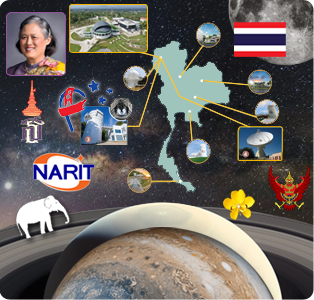
National Astronomical Research Institute of Thailand (NARIT) and Tourism Authority of Thailand are facilitating 7 astronomy tours for domestic tourists from December 2020 (Thai / Buddhist year 2563) through March 2021. Thailand is celebrating the ‘Great Conjunction’ December 19-23, followed by NARIT AstroFest January 9, 2021, and Thai National Observatory (TNO) Open House on February 13 and March 6. The establishment of NARIT in 2008 (first founded as NARI in 2004) has led to rapid development of astronomy facilities in the nation. NARIT oversees telescopes in 13 different locations for academic / public and research / science: observatories in Nakhon Ratchasima, Chachoengsao, Songkhla, Khon Kaen (under construction); the 2.4-meter TNO (built 2013) one of the largest in Southeast Asia and situated on the highest Thai mountain 2,565-meter Doi Inthanon; the 40-meter single-dish Thai National Radio Telescope (2020); and Thai Robotic Telescope Network operating 0.6-0.7 meter telescopes in Chile, PRC / Zhongguo, Australia, USA and at a location yet to be selected in South Africa. NARIT also manages the 21-acre, US$13M Princess Sirindhorn AstroPark in Chiang Mai. Her Royal Highness Princess Maha Chakri Sirindhorn, whose exceptionally keen interest in astronomy is well known for decades, has earned the nickname “Princess of Astronomy” and international admiration for her dedication / philanthropy to science and education – worthy of a Nobel Peace Prize nomination. (Image Credits: Thai Bureau of the Royal Household, NARIT, TNO, NASA)

MONDAY

Highlights…
Dec 21 — ISS, ~405-km LEO: Expedition 64 crew of 7 attend to ongoing cardiac investigations within Kibo Lab module Life Sciences Glovebox; maintaining rigorous exercise regime to stave off muscle atrophy; Mission Control reviewing cause / prevention of temporary power loss to 4B channel.

Dec 21 NewSpace: Astra reviewing data / preparing for next test after 2nd launch from Pacific Spaceport Complex in Kodiak AK; Spin Launch at Spaceport America aims for first test launches 2021; Earth observation company Changguang Satellite of China to build constellation with US$375M funding.

Dec 21 — Solar System: Chang’e-5 lunar samples being analyzed by NAOC, Pei Zhaoyu of CNSA offers international access; Hayabusa2 project manager Yuichi Tsuda reveals ‘good amount’ of mixed sand/rock and gas samples in return capsule; Hubble observes Atlantic-sized storm on Neptune veer, change course.

Dec 21 — Galaxy: Simulation of 100k random planets shows 3B years of habitability on Earth may be due to chance / observer selection; Borexino detects CNO neutrinos, key elements indicative of fusion process thought to power large stars; exoplanet HD 106906 b, 336 LY distant, being studied as orbital analog to hypothetical TNO ‘Planet 9’.

Dec 21 — Global: China / Zhongguo Long March 8 new generation rocket awaiting inaugural launch at Wenchang SLC this month; Indonesia President Joko Widodo and SpaceX CEO Elon Musk in talks to bring battery factory and launch site to Indonesia; Thailand planning lunar orbit mission within 7 years.

Dec 21 — USA: Artemis Accords gains support in South America with Brazil statement of intent; Artemis 2 lunar flyby mission to include Canada Astronaut; KSC researcher to spend year studying isolated agriculture at DLR Antarctic greenhouse.

Dec 21 — Hawai’i: Keck observations confirm distance of farthest Galaxy GN-z11 – noting UV flash, Observatory also updating solar power system; CFHT data being used to study / confirm binary system composed of two young planet-like objects.

NET Dec 21 — Boeing, NASA, Stennis Space Center MS: SLS core stage hot fire test planned.

= All times

for terrestrial events in local time unless noted.

= All times for international terrestrial events in local time unless noted.

= All times for space events, and…

= All times for international space / astro events in Hawaii Standard Time unless noted. Add 10 hours to obtain UT (‘Universal Time’).


Weekly Planet Watch Evening Planets: Mars (S), Jupiter (SW), Saturn (SW), Uranus (SE), Neptune (SW); Morning Planets: Venus (SE).

Jupiter – Saturn Great Conjunction on December Solstice is Poignant Symbol of Space Age  

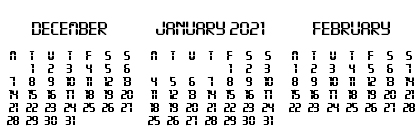
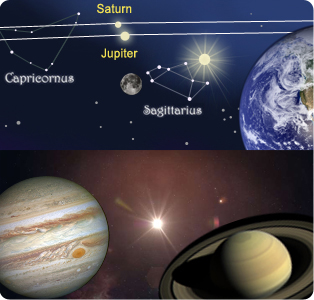
The 2 largest planets in the Solar System will align within 0.101° (1/5 of the diameter of a full Moon) of one another from geocentric point of view on December 21 – Winter Solstice in the Northern Hemisphere, Summer Solstice in the Southern. Human fascination with astronomical conjunctions, and specifically so-called Great Conjunctions of Jupiter and Saturn (the rarest of bright-planet conjunctions, owing to slow orbits) has a rich archeoastronomical history, perhaps most famously speculated as the “Christmas Star” in Biblical lore. While there was a closer Great Conjunction in 1623 (0.086°), no observation was recorded due to conditions. The most recently observed ‘Double Planet’ conjunction of the behemoth gas giants stretches back to 1226 and is thought to have influenced Genghis Khan to withdraw his armies from China. With modern technology, humanity has extended its reach to the farthest reaches of the Solar System, with Juno currently in orbit and Pioneer / Voyager missions conducting flybys of both giants, gaining momentum from gravity assist on the way to interstellar medium. This aspect of orbit mechanics has been described in detail by Serbian researcher Nataša Todorović in the just-released paper The arches of chaos in the Solar System, identifying outward manifold pathways through space generated by planets with dramatic effect on object speed. Notably, the upcoming Great Conjunction will be the first observed by humans living in Space. (Image Credits: NASA)

Dec 21 — Firefly Aerospace, Launch Alpha Rocket, SLC-2 Vandenberg AFB CA: First launch attempt of Alpha rocket to reach space; launch window open through Jan 31, 2021.

Dec 21 — Texas A&M University, Commerce TX: Mystery of the Christmas Star – Planetarium Showing; reproducing the skies as seen from Bethlehem more than 2,000 years ago; 20:00.

Dec 21-22 — Center for Astrophysics and Gravitation (CENTRA), Instituto Superior Técnico (IST), Lisbon, Portugal: XIII Black Holes Workshop: Celebrating  the Nobel Prize 2020 for black holes.

Dec 21 — December Solstice: The Sun reaches the point where it is farthest South of the celestial equator, marking the shortest day and longest night of the year (opposite in Southern Hemisphere); 00:02.

Dec 21 — Moon: At first quarter, 13:41.

Dec 21 — Jupiter: 0.10° SE of Saturn, 09:00; will appear as a ‘double planet’, for the first time since July 16, 1623; next occurrence 2080, then 2400.

Dec 21 — Apollo Asteroid 2017 XQ60: Near Earth Flyby (0.032 AU)

Dec 21 — Apollo Asteroid 2020 XA3: Near Earth Flyby (0.033 AU)

Continued From…

Nov 4, 2020 – Feb 28, 2021 — International Astronautical Federation, Online: Abstracts Submission Open: 72nd International Astronautical Congress (IAC 2021); being held Oct 25-29.

Dec 19-23 — NARIT, Tourism Authority of Thailand, Multiple Locations, Thailand: Celebrating the Great Conjunction of Jupiter and Saturn, NARIT and TAT hold stargazing tours for domestic tourists.

TUESDAY

Dec 22 — ISS, ~405-km LEO: In-flight interviews with Expedition 64 Astronauts Kate Rubins and Victor Glover (09:10 EST), and Victor Glover and Shannon Walker (12:35 EST), live coverage available.

Dec 22 — The Space Show, Online / Tiburon CA: Dr. David Livingston talks with Ajay Kothari, President and Founder of Astrox Corporation of Washington DC.

Dec 22 — Ursid Meteor Shower Peak: Appearing to radiate from β star of Ursa Minor, Ursids are associated with comet 8P/Tuttle, they offer medium speed (33 km/sec), mostly faint with a few fireballs, ~15 per hour, visible in northern Hemisphere.

Dec 22 — Apollo Asteroid 2020 XH6: Near Earth Flyby (0.016 AU)

WEDNESDAY

Dec 23 — Moon: 5.1° SE of Mars, 14:00.

Dec 23 — Venus: 5.6° N of Antares, 11:00.

Dec 23 — Apollo Asteroid 2020 XJ3: Near Earth Flyby (0.013 AU)

THURSDAY

Dec 24 — Hubble Space Telescope, LEO: Spacecraft makes visible pass over Hawai’i starting 05:18:05 from SSW to 05:23:53 in E, magnitude 2.1.

Dec 24 — Moon: At apogee (distance 405,013.16 km), 07:00; 3.2° SE of Uranus, 16:00.

Dec 24 — Aten Asteroid 2011 CL50: Near Earth Flyby (0.003 AU)

FRIDAY

Dec 25 — Mars Express, Mars Orbit: ESA spacecraft reaches 17 full years / enters 18th year in Mars orbit today; will continue to study Mars atmosphere & climate, planet structure, mineralogy, geology, and search for traces of water; launched June 2, 2003.

Dec 25 — Aten Asteroid 501647 (2014 SD224): Near Earth Flyby (0.020 AU)

Dec 25 — Apollo Asteroid 2020 XY: Near Earth Flyby (0.040 AU)

SATURDAY

Dec 26 — Solar Orbiter, Heliocentric Orbit: Dedicated to solar and heliospheric physics, ESA Solar Orbiter to perform 1st Venus flyby today for gravity assist to reach its operational orbit (over next 3.5 years) with perihelion 0.28 AU and aphelion 0.91 AU; launched February 10, 2020.

Dec 26 — Moon: 5.8° SE of Pleiades 16:00.

Dec 26 — Apollo Asteroid 2018 XE4: Near Earth Flyby (0.014 AU)

Dec 26 — Aten Asteroid 2012 XE133: Near Earth Flyby (0.031 AU)

Dec 26 — Apollo Asteroid 2020 XT2: Near Earth Flyby (0.034 AU)

SUNDAY

Dec 27 — The Space Show, Online / Tiburon CA: Dr. David Livingston hosts open lines for call-in discussions.

Dec 27 — Moon: 4.6° N of Aldebaran, 10:00.

Dec 27 — Aten Asteroid 2016 AF2: Near Earth Flyby (0.019 AU)