International Spacecraft Exploring the Solar System and Beyond
Voyager 1 is in interstellar space, ~141 AU from Earth, headed for Gliese 445. The probe’s 8-track Digital Tape Recorder is scheduled to turn off in 2018. Voyager 2 is in the heliosheath, ~117 AU from Earth, headed for Sirius with anticipated arrival in ~250,000 years. The probes are expected to communicate until at least 2025. New Horizons is scheduled to awaken from hibernation on June 4 and encounter KBO Ultima Thule, meaning ‘beyond the borders of the known world’, on January 1, 2019, 05:33 UTC. This will be the most distant flyby in history at ~40 AU from Earth. The mission has been extended through 2021 to explore additional KBO. Juno is in a highly elliptical orbit near Jupiter. The 11th flyby will gather data on weather, rings, and composition. Juno intends to operate through July 2018 with anticipated mission extension approval. Within the asteroid belt, Dawn continues to circle the ice world of Ceres every 5.4 hours. It plans to fire an ion engine on April 17, beginning a downward spiral to its smallest to date elliptical orbit by the first week of June. Mars Curiosity Rover, currently on Vera Rubin Ridge, surpasses 2,008 Sols. It plans to utilize a new drilling method to retrieve samples and surface data. Akatsuki five cameras continue to observe Venus atmosphere with data releases June 1 and December 1. (Image Credit: NASA, ESA, JPL, JAXA, Akihiro Ikeshita) |
MONDAY Ongoing…
|

 Apr 2 —
  Apr 2 — NewSpace:
  Apr 2 — USA: White House releases brief summary on
 = All times
for terrestrial events in local time unless noted.
 = All times for international terrestrial events in local time unless noted.
 = All times for space events, and…
 = All times for international space / astro events in Hawaii Standard Time unless noted. Add 10 hours to obtain UT (‘Universal Time’).
Weekly Planet Watch – Evening Planets: Mercury (W), Venus (W); Morning Planets: Mars (SE), Jupiter (S), Saturn (SE).
Vienna Hosts 2018 EGU, and Home to Significant Space Organizations
|
Apr 2 — SpaceX, Launch Falcon 9 / CRS 14, Cape Canaveral AFS FL: SpaceX Falcon 9 rocket set to launch 16th Dragon spacecraft on 14th operational cargo delivery mission to ISS.
Continued from…
TUESDAY
WEDNESDAY
|

THURSDAY
Apr 5 — SpaceX, Launch Falcon 9 / Bangabandhu 1, Cape Canaveral AFS FL: SpaceX Falcon 9 rocket to launch Bangabandhu 1 communications satellite for Bangladesh Telecommunication Regulatory Commission.
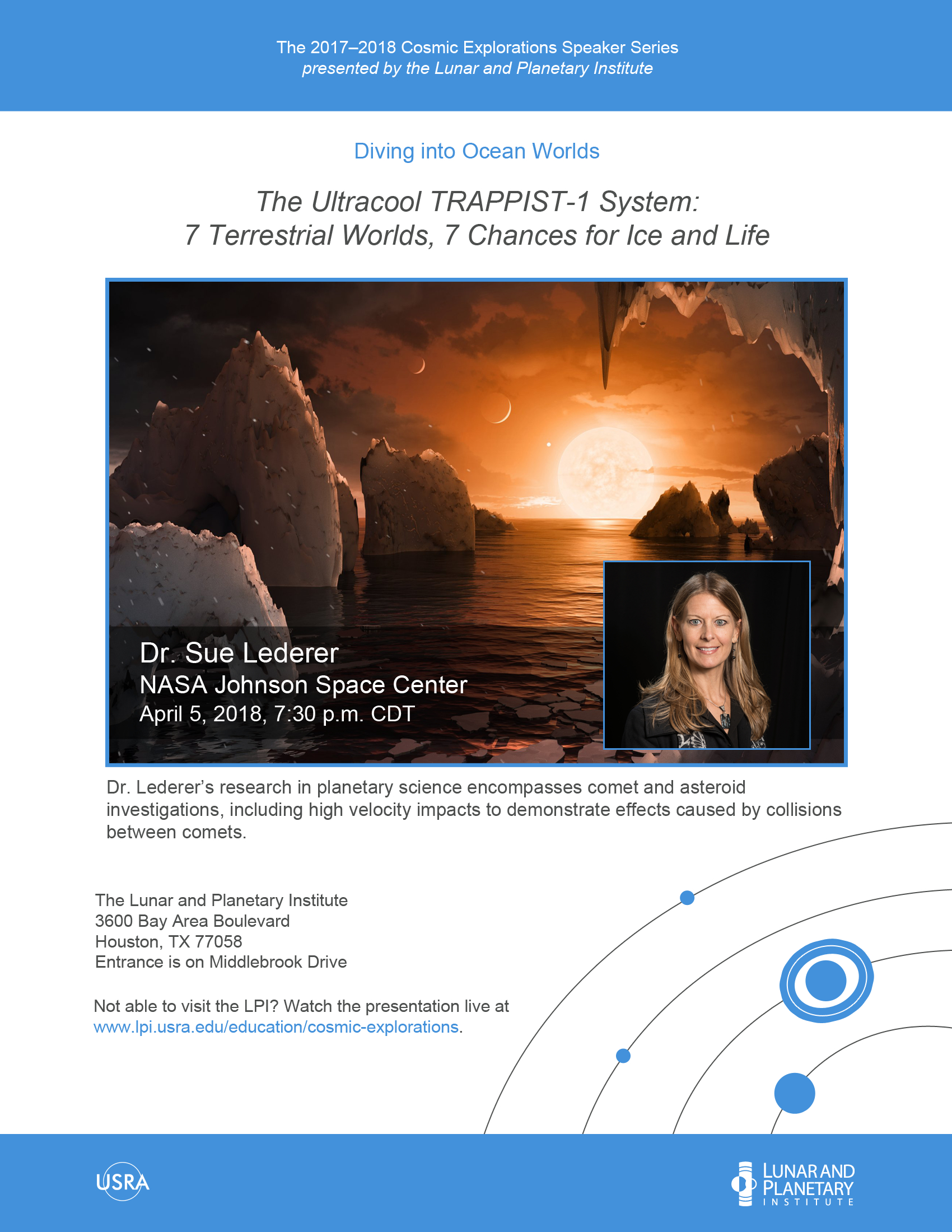
Apr 5 — Lunar and Planetary Institute, Houston TX: 2017-2018 Cosmic Explorations Lecture: The Ultracool TRAPPIST-1 System – 7 Terrestrial Worlds, 7 Chances for Ice and Life; Sue Lederer of the Orbital Debris Program Office at the Johnson Space Center, 19:30.
Apr 5-7 — Secure World Foundation, University of Pennsylvania Center for Ethics and the Rule of Law, Philadelphia PA: The Weaponization of Outer Space: Ethical and Legal Boundaries.
Apr 5 — Apollo Asteroid 2018 FW4: Near-Earth Flyby (0.025 AU)
FRIDAY
Apr 6-8 — AIAA, Merced CA: Region VI Student Conference; venue for students, faculty and industry professionals to interact and discuss current aerospace topics.
SATURDAY
Apr 7 — National Air and Space Museum, BrightestYoungThings.com, Yuri’s Nigh , Washington DC: National Air and Space Museum + BYT + Yuri’s Night present 2001: A Space Party.
Apr 7 — Jet Propulsion Laboratory, NASA/Caltech, Pasadena CA: Educator Workshop: Discussing Climate Science in the Classroom; for Teachers of grades 5-12.
Apr 7 — AIAA San Fernando Pacific Chapter, Online / CA and HI: “Voyager 3 Mission” Essay due for High Student Scholarship Contest.
Apr 7-8 — German Federal Ministry of Education and Research,Tech Gate Vienna, Vienna, Austria: 1st PalMod International Open Science Conference.
Apr 7 — Moon: 1.9° N of Saturn, 03:00; 3.1° N of Mars, 08:00; at apogee (distance 404,120 km), 20:00.
Apr 7 — Moon: Last Quarter, 21:20.
SUNDAY
Apr 8-13 — European Geosciences Union (EGU), Vienna, Austria: EGU General Assembly 2018.
Apr 8 — Moon: 1.5° N of Pluto, 03:00.
Apr 8 — Amor Asteroid 2018 CZ13: Near-Earth Flyby (0.072 AU)
Apr 8 — Amor Asteroid 2018 FV3: Near-Earth Flyby (0.086 AU)