Venus Captures Attention of Astrophysicists, Planetary Scientists and Explorers
|
MONDAY Highlights…
|
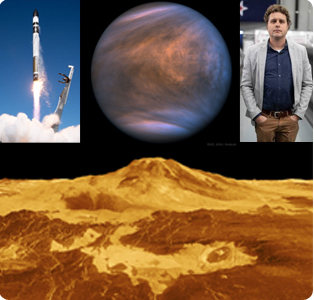 Closest Earth neighbor Venus may hold the answer to the most perennially contemplated query of humankind: the existence of extraterrestrial life and its distribution in the universe, as well as give insight into climate change processes on Earth. Recent analysis of spectroscopic observations at ALMA in Chile and James Clerk Maxwell Telescope in Hawaii conducted at Cardiff University indicate the presence of Venusian atmospheric phosphine, a terrestrial biomarker thought to have astrobiological relevance. Lead study author Jane Greaves is invited to talk on the possibility of phosphine at 18th Meeting of the Venus Exploration and Analysis Group (VEXAG) being held virtually Nov 16-17. Another investigation of ALMA data conducted by researchers in West Bengal, India has identified the amino acid glycine in Venusian mid-latitudes. Although these findings are under methodological scrutiny by the scientific peer-review process, ultimately further exploratory missions will be necessary to judge validity of Earth-based readings. Rocket Lab CEO Peter Beck is determined to explore Venus for life-signs with a series of missions starting 2023. Beck proposes utilization of the proven workhorse Electron rocket in conjunction with Photon smallsat platform to thoroughly analyze the atmosphere of Venus in a commercial / academic collaboration with researchers at MIT, JPL and Oxford. With Electron reusability attempt set for Nov 15 and Artemis lessons to be learned via Capstone in 2021, Rocket Lab is well positioned to achieve the transcendent. (Image Credits: ISAS, NASA, Rocket Lab)
 Nov 16 —
  Nov 16 — NewSpace:
  Nov 16 — USA:
 = All times
for terrestrial events in local time unless noted.
 = All times for international terrestrial events in local time unless noted.
 = All times for space events, and…
 = All times for international space / astro events in Hawaii Standard Time unless noted. Add 10 hours to obtain UT (‘Universal Time’).
Weekly Planet Watch – Evening Planets: Mars (ESE), Jupiter (WSW), Saturn (WSW), Uranus (E), Neptune (S); Morning Planets: Venus (E), Mercury (SSE).
3rd Symposium on Peaceful Use of Space Technology Being Held in-Person and Online
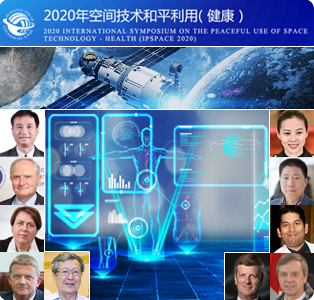
The 3rd IPSPACE 2020 – Health is set for November 18–19 at three parallel venues in China (Presidential Hotel, Beijing), Europe and USA as well as 20 sub-venues around the world and online. This annual event is hosted by the International Peace Alliance, Chinese Society of Astronautics and China High-Tech Industrialization Association, with support from IAA, IAF, IISL, ASE, ISU, Space Foundation and Rice University International Space Medicine Summit. It aims to promote the peaceful use of space technology for the betterment of peoples of Earth. With the slogan “One Space, One Home” and theme “Space technology and pandemic control / prevention” this conference will feature 2 Plenary Sessions, 5 Tracks, and opening and closing ceremonies. Some speakers include (TL-TR) CSA Secretary General Wang Yiran, IAF Executive Director Christian Feichtinger, UNOOSA Director Simonetta Di Pippo, Director of Russian Academy of Sciences IBMP Oleg Orlov, Former JAXA VP Hiroki Matsuo, Space Foundation VP Steve Eisenhart, Canada Astronaut Robert Thirsk, Farhan Asrar of International Space University, China Astronauts Yang Liwei and Wang Yaping, and iSpace China VP Huo Jia. Topics covered include remote sensing, space medicine, commercialization of space, international collaborations for peaceful use of space, space communication and navigation, mass spectrometry-based microorganism identification systems, Hainan satellite industry, aerospace revolution to meet new world challenges, and next-gen space education and projects. (Image Credits: IPA, CSA, CHIA, IAF, IAA, ISSL, ASE, ISU, SF, ISMS, NASA, Xinhua / Liu Jinhai) |
NET Nov 16 — Arianespace, Launch Vega / EOSat-Ingenio & Taranis, Kourou, French Guiana: Arianespace Vega rocket, designated VV17, to launch SEOSat-Ingenio Earth observation satellite and Taranis scientific research satellite.
Continued From…
|
TUESDAY
Nov 17 — NASA, Online / Washington DC: NASA Science Mission Directorate Town Hall Meeting; with Thomas Zurbuchen discussing current status of activities and 2021 NASA Science Planning Guide; 15:00 EST.
Nov 17 — National Academies of Sciences, Engineering and Medicine, Online / Washington DC: Online: Planetary Science and Astrobiology Decadal Survey 2023-2032 – Panel on Mars Meeting 2 and Panel on Giant Planet Systems Meeting 3.
Nov 17-19 — SmarterShows, ArianeGroup, ExoLaunch, OHB, et al, Berlin, Germany: Space Tech Expo Europe 2020; reset to Nov 16-18, 2021.
Nov 17 — Leonid Shower Peak: Appearing to radiate from constellation Leo, Leonids are associated with the comet Tempel–Tuttle; can produce 10 to 15 meteors per hour.
Nov 17 — Apollo Asteroid 2020 VY: Near Earth Flyby (0.042 AU)
WEDNESDAY
NET Nov 18 — SpaceX, Launch Falcon 9 / NROL-108, SLC-40, Cape Canaveral AFS: SpaceX Falcon 9 rocket to launch classified spacecraft payload for U.S. National Reconnaissance Office.
Nov 18 — ISS, Russian EVA #47, ~405-km LEO: Expedition 64 Cosmonauts Sergey Ryzhikov and Sergey Kud-Sverchkov to begin 6-hour spacewalk at 09:30 EST, live coverage available.
 Nov 18 — W. M. Keck Observatory, Online: Keck Astronomy Talks: A Planet Not Our Own; by Elizabeth Tasker, Associate Professor, JAXA / Institute of Space and Astronautical Sciences, 17:00 HST.
Nov 18 — Space Foundation, Online: Space Symposium 365 Webinar: Expedition One: The Beginning; celebrating 20th anniversary of 1st ISS Crew featuring Bill Shepherd of NASA, Yuri Gidzenko and Sergei Kirkalev of Roscosmos; 14:00 EST.
Nov 18 — National Academies of Sciences, Engineering and Medicine, Online / Washington DC: Online: Planetary Science and Astrobiology Decadal Survey 2023-2032 – Panel on Small Solar System Bodies Meeting 4.
Nov 18-19 — SpaceCom, Online / Houston TX: 6th SpaceCom 2020; Global Commercial Space Conference and Exposition.
Nov 18-19 — International Peace Alliance, Chinese Society of Astronautics, China High-Tech Industrialization Association, et al, International Locations and Online: 3rd Symposium on the Peaceful Use of Space Technology – Health (IPSPACE 2020); taking place at 3 parallel main venues in USA, Europe and China, and 20 sub-venues around the world with an online and offline format.
Nov 18 — Apollo Asteroid 2020 VQ2: Near Earth Flyby (0.010 AU)
THURSDAY
Nov 19 — Virgin Galactic, Spaceport America, Las Cruces NM: VG to attempt VSS Unity space plane third piloted test flight to suborbital space between Nov 19-23.
Nov 19 — APRSAF, SSTL, MEXT, JAXA, VAST, LAPAN, Online / Tokyo, Japan: 27th Asia-Pacific Regional Space Agency Forum (APRSAF-27); 13:00-17:00 local time.
Nov 19 — LPI, USRA, NASA, Online / Houston TX: 6th Lunar Surface Science Workshop: Foundational Data Products.
Nov 19 — Space Foundation, Online: Space Symposium 365 Webinar: New Generation Space Leaders Panel: Unmute Yourself: Be Heard in the Virtual World; 13:00 EST.
Nov 19 — Cornell University, Online / Ithaca NY: Habitability at the End of the Universe; 16:00-17:00 EST.
Nov 19 — Moon: 2.50° SE of Jupiter, 00:00; with Jupiter and Saturn within circle of diameter 3.78°, 03:00; 2.85° SE of Saturn, 06:00.
FRIDAY
Nov 20 — Swift, LEO: Observing gamma-ray bursts & their afterglows in gamma-ray, X-ray, ultraviolet, optical wavelengths from LEO, craft reaches 16 full years / begins 17th year of operations in space today, launched in 2004.
Nov 20 — National Academies of Sciences, Engineering and Medicine, Online / Washington DC: Online: Planetary Science and Astrobiology Decadal Survey 2023-2032 – Panel on Mercury and the Moon Meeting 3.
Nov 20 — University of Oxford, St Cross College, Online: Lecture: Physics of the Impossible Revisited; by Professor Michio Kaku from City College of New York, 17:00 UTC.
Nov 20 — Apollo Asteroid 2020 VA1: Near Earth Flyby (0.030 AU)
SATURDAY
Nov 21 — SpaceX, Launch Falcon 9 / Sentinel 6-Michael Freilich, SLC-4E, Vandenberg AFB CA: Falcon 9 rocket to launch Sentinel 6A dubbed “Jason-CS A” and “Sentinel 6-Michael Freilich”; joint mission between ESA, NASA, NOAA, CNES and Eumetsat.
Nov 21 — British Interplanetary Society, Online / London, United Kingdom: Lecture: Optimum Interplanetary Trajectory Software from Interplanetary to Interstellar; by Adam Hibberd, 14:00 UTC.
Nov 21 — Moon: At first quarter, 18:45.
Nov 21 — Apollo Asteroid 2020 VR2: Near Earth Flyby (0.016 AU)
SUNDAY
Nov 22 — Neptune Trojan 2015 VV165: At opposition (27.349 AU)