China / Zhongguo Long March 5 Return to Flight Vital For 2020s Chang’e Moon, Mars, Human Missions
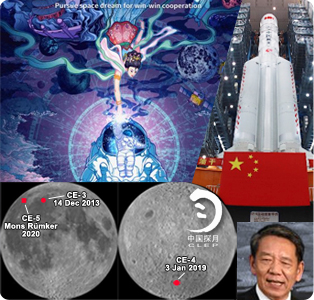
The 3rd heavy-lift Long March 5 (LM-5) rocket is scheduled to launch December 27 from China newest and most southern launch center at Wenchang, Hainan Island 19° N. Carrying 8,000-kg Shijian 20 tech demo satellite into geosynchronous orbit, it will be the first LM-5 flight in ~30 months. Success is critical for China 2020 commitments to launch its first lunar sample return mission Chang’e-5, first Mars mission Huǒxīng-1 (Mars-1) of a rover and orbiter July 23, conduct variant Long March 5B test, and fly next-gen human spacecraft. CE-5 is expected to launch NET July 2020 to Mons Rümker Region 40.8° N, 58.1° W and return to Earth within one month. Back-up CE-6 could launch to collect samples near Moon South Pole after CE-7 lands on Shackleton Rim NET 2023. CE-8 may be the final robotic mission before China lands humans on the Moon. 21st Century China / International / USA Artemis collaboration for Moon Village settlement could be on the horizon. CE-6 will have international payloads aboard. Data from far-side CE-4 and its 4 international payloads is expected to be shared publicly; similar to CE-3 which enters its 7th year / reaches 6 full years of operation Dec 14. In July 2029, CE-2 in Deep Space will come within 7M km of Earth after reaching 300M km apogee. (Pictured: CLEP Designer Wu Weiren; Image Credits: CNSA, CCTV / screengrab)
|
MONDAY
Highlights…
 Dec 9 — ISS, 405-km LEO: Expedition 61 six-member crew expects arrival of Dragon CRS-19 after weather delay, supply materials include Robotic Tool Stowage also dubbed ‘robot hotel’; fourth and final EVA for Alpha Magnetic Spectrometer repairs to be scheduled, should return AMS to nominal operations. Dec 9 — ISS, 405-km LEO: Expedition 61 six-member crew expects arrival of Dragon CRS-19 after weather delay, supply materials include Robotic Tool Stowage also dubbed ‘robot hotel’; fourth and final EVA for Alpha Magnetic Spectrometer repairs to be scheduled, should return AMS to nominal operations.
 Dec 9 — NewSpace: SpaceX preparing for crucial in-flight abort test of Crew Dragon in December, postpones some Starship construction in Florida to focus on work in Texas; Blue Origin expands facilities in Seattle WA and Southern CA; Rocket Lab moving into Long Beach CA location alongside Virgin Orbit and SpinLaunch. Dec 9 — NewSpace: SpaceX preparing for crucial in-flight abort test of Crew Dragon in December, postpones some Starship construction in Florida to focus on work in Texas; Blue Origin expands facilities in Seattle WA and Southern CA; Rocket Lab moving into Long Beach CA location alongside Virgin Orbit and SpinLaunch.
Dec 9 — Solar System: Lunar Reconnaissance Orbiter also images impact site of Vikram lander; MRO data reveals global storms on Mars; OSIRIS-REx team chooses from 4 candidate landing sites on asteroid Bennu; New Mexico solar telescope study shows how magnetic waves leave Sun interior while Parker Solar Probe releases new results.
Dec 9 — Galaxy: China astronomers discover black hole LB-1 with mass over 70 solar masses, defying current theories of black hole formation; 19 dwarf galaxies found to lack mysterious dark matter; data from retired Kepler Space Telescope leads to new estimate for age of Milky Way disk.
Dec 9 — Global: ESA ministers approve massive 45% increase in 3-year budget; China CAST unveils photo of Mars Explorer to be launched in 2020; Mexico students build AzTechSat-1 cubesat for launch to ISS.
 Dec 9 — USA: Artemis 2 propellant tanks prepared for next phase of construction; NASA shares mid-sized robotic lunar lander concept; Sierra Nevada, selected as a CLPS provider, unveils lunar lander concept. Dec 9 — USA: Artemis 2 propellant tanks prepared for next phase of construction; NASA shares mid-sized robotic lunar lander concept; Sierra Nevada, selected as a CLPS provider, unveils lunar lander concept.
Dec 9 — Hawai’i: Keck Telescope images interstellar comet 2I/Borisov, revealing a tail 160,000-km long; Subaru Telescope finds signs of organic molecules in Comet 21P/Giacobini-Zinner; Hawai’i County Council votes to accept US$10M state grant for Mauna Kea Big Telescope related costs.
 Dec 9-10 — NASA, Michoud Assembly Facility, New Orleans LA: Artemis Day; social media users invited to view Space Launch System core stage for Artemis 1, and to tour Stennis Space Center in Mississippi. Dec 9-10 — NASA, Michoud Assembly Facility, New Orleans LA: Artemis Day; social media users invited to view Space Launch System core stage for Artemis 1, and to tour Stennis Space Center in Mississippi.
|
 = All times
for terrestrial events in local time unless noted.
 = All times for international terrestrial events in local time unless noted.
 = All times for space events, and…
 = All times for international space / astro events in Hawaii Standard Time unless noted. Add 10 hours to obtain UT (‘Universal Time’).
Weekly Planet Watch – Evening Planets: Venus (SW), Jupiter (SW), Saturn (WSW), Uranus (E), Neptune (S); Morning Planets: Mercury (ESE), Mars (ESE).
International Conference Talks About Orbital Debris While AGU Looks To Moon and Mars
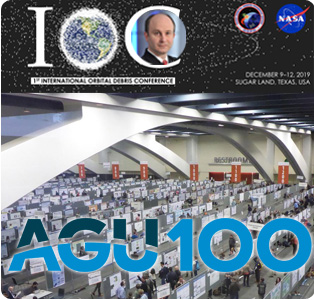
The First International Orbital Debris Conference December 9-12 in the town of Sugar Land near Houston, Texas will be hosted by LPI, USRA, NASA and AGI. IOC will cover all aspects of micrometeoroid and orbital debris research, highlighting research in USA and encouraging collaborations with the international community. Holger Krag of ESA Space Debris Office estimates there are about 1 million pieces of space junk larger than 1 cm, all of which could pose a danger. During 2019 ESA Aeolus Earth observation satellite has been moved to avoid collision with one of the SpaceX Starlink satellites, which are also a concern of astronomers. The Inter-Agency Space Debris Coordination Committee proposes guidelines to mitigate the creation of space debris. An IADC study using 6 different models shows that even in a near-perfect scenario of 90% compliance with the guidelines, a collision could be expected every 5-9 years. ESA proposes active removal missions to clean up space debris. Satellites will also be among the topics for over 25,000 attendees at the 100th American Geophysical Union Fall Meeting at San Francisco Moscone Center. On Dec 11 a plenary talk will discuss the future of Moon and Mars exploration in the age of Artemis. Another panel “New Access to Space” will focus on nations and commercial enterprises sending spacecraft to lunar orbit and the lunar surface. (Image Credits: IOC, ESA, USGS)
|
Dec 9 — Apollo Asteroid 2019 XY: Near-Earth Flyby (0.008 AU)
Dec 9 — Apollo Asteroid 2019 WO2: Near-Earth Flyby (0.012 AU)
Dec 9 — Apollo Asteroid 2019 WT3: Near-Earth Flyby (0.025 AU)
Dec 9 — Aten Asteroid 2019 XB: Near-Earth Flyby (0.044 AU)
Dec 9-11 — The National Academies of Sciences, Engineering and Medicine, Irvine CA: Astro2020 Meeting: Decadal Survey on Astronomy and Astrophysics 2020.
Dec 9-13 — LPI, USRA, NASA, AGI, Houston TX: 1st International Orbital Debris Conference (IOC).
Dec 9-13 — American Geophysical Union (AGU), San Francisco CA: 100th American Geophysical Union (AGU) Fall Meeting.
Continued from…
Jan 2019 – Sep 2020 — New Horizons, Kuiper Belt: Full data collected from 7 instruments during KBO Ultima Thule flyby to be transmitted to Earth over this time period.
Nov 2019 – Nov 2020— Hayabusa2, Earth Trajectory: JAXA Hayabusa2 with two samples collected from C-type asteroid 162173 Ryugu on trajectory for Earth return.
Nov 29 – Dec 5 — European Commission, EU Space Programme, Copernicus, EGNOS, Galileo Network, ESA, et al, Helsinki, Finland: European Space Week 2019; featuring keynotes, discussions and conference sessions, hackathon, accelerator boot camp, a festive awards ceremony and more.
Dec 8-13 — International Committee on Global Navigation Satellite Systems, UNOOSA, Bengaluru, India: 14th Meeting of the International Committee on Global Navigation Satellite Systems (ICG). |
TUESDAY
Dec 10 — XMM-Newton, Very Eccentric Elliptical LEO: ESA craft studying X-ray emissions, star-forming regions, galaxy clusters, environment of supermassive black holes, mapping dark matter, reaches 20 full years / begins 21st year in space today, launched 1999.
Dec 10 — Roscosmos State Corporation, Launch Soyuz / Glonass M, Plesetsk Cosmodrome, Russia: Soyuz-2.1b booster with Fregat upper stage to launch Glonass M navigation satellite.
Dec 10 — Royal Aeronautical Society, London, United Kingdom: Lecture: Building, Testing and Developing a Private Spaceline: Virgin Galactic and Commercial Space; by David Mackay, Chief Pilot at VG.
Dec 10-12 — Fondazione E. Amaldi, Fiera Roma, Space Foundation, Italian Space Agency, Space Generation Advisory Council, Rome, Italy: New Space Economy (NSE) European ExpoForum.
Dec 10 — American Association of University Women (AAUW) Kona Branch, Kailua-Kona HI: GEMS – Girls Exploring Math and Science 2019.
Dec 10 — Moon: 7.3° SSE of Pleiades, 09:00.
Dec 10 — Apollo Asteroid 2019 XW: Near-Earth Flyby (0.028 AU)
Dec 10 — Apollo Asteroid 2011 WN15: Near-Earth Flyby (0.058 AU)
WEDNESDAY
Dec 11 — 300th Observation of 1st Recorded Sighting of the Aurora Borealis: While study of aurorae for Mars, Jupiter, Saturn, Uranus, Neptune and other locations are ongoing, today marks 300th anniversary of Earth Aurora Borealis first recorded sighting.
Dec 11 — Moon: 2.95° N of Aldebaran, 01:00; Full Cold Moon, 19:14.
Dec 11 — Venus: 1.80° S of Saturn, 00:00.
THURSDAY
Dec 12 — University of Wisconsin – Madison, Department of Astronomy, Madison WI: Lecture: On the Morphologies of Cool Circumgalactic Gas Flows: Insights from Absorption and Emmission-Line Tracers; by Kate Rubin of San Diego State University.
Dec 12 — Apollo Asteroid 2015 XX169: Near-Earth Flyby (0.071 AU)
FRIDAY
Dec 13 — Royal Astronomical Society, London, United Kingdom: Royal Astronomical Society (RAS) Ordinary Meeting; X-ray Astrophysics from XMM-Newton to Athena – The Heritage of XMM and Opportunities of Athena; Cometary Science with Rosetta – Striking, Timely, and More to Come!
Dec 13 — Venus: 1.13° S of Pluto, 06:00.
Dec 13 — Aten Asteroid 2019 XO1: Near-Earth Flyby (0.020 AU)
Dec 13 — Apollo Asteroid 2010 VC140: Near-Earth Flyby (0.081 AU)
SATURDAY
Dec 14 — NEOWISE, LEO: NASA Wide-field Infrared Survey Explorer spacecraft (redubbed Near-Earth Object WISE – NEOWISE) reaches 10 full years / begins 11th year in space; launched 2009.
Dec 14 — Chang’e-3 Lander, Guang Han Gong, Sinus Iridum / Mare Imbrium, 44.12°N 19.51°W, Moon Surface: Spacecraft enters 7th year / reaches 6 full years on Moon surface, landed 2013.
Dec 14-15 — Space Generation Advisory Council, Roketsan, ISU, Aselsan, Gumish, Istanbul, Turkey: 1st Middle East Space Generation Workshop (ME-SGW).
Dec 14 — Geminids Meteor Shower Peak: Appearing to radiate from constellation Gemini, shower can produce 80-130 meteors per hour; bright, medium-slow meteors (35 km/sec).
Dec 14 — Moon: 5.3° S of Pollux, 08:00.
Dec 14 — Apollo Asteroid 2019 WP6: Near-Earth Flyby (0.016 AU)
SUNDAY
Dec 15 — SpaceX, Launch Falcon 9 / JCSAT 18 & Kacific 1, LC-40, Cape Canaveral AFS FL: Launch of JCSAT 18 & Kacific 1 communications satellite jointly owned by SKY Perfect JSAT Corp. of Japan and Kacific Broadband Satellites of Singapore.
 Dec 15 — The Space Show, Online / Tiburon CA: Dr. David Livingston talks with Jeffrey Morris, Founder of FutureDude Entertainment.
Dec 15 — Mercury: 5.0° NNE of Antares, 21:00.