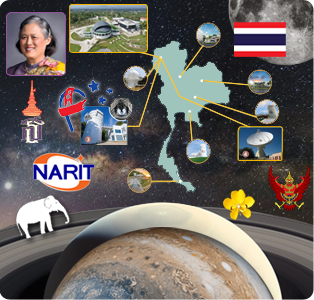
Thailand Hosts Astronomy Tours Through March 2021, Looks Forward to New Observations from New Locations
|
MONDAY Highlights…
|
 Dec 21 —
  Dec 21 — NewSpace:
  Dec 21 — USA:
 = All times
for terrestrial events in local time unless noted.
 = All times for international terrestrial events in local time unless noted.
 = All times for space events, and…
 = All times for international space / astro events in Hawaii Standard Time unless noted. Add 10 hours to obtain UT (‘Universal Time’).
Weekly Planet Watch – Evening Planets: Mars (S), Jupiter (SW), Saturn (SW), Uranus (SE), Neptune (SW); Morning Planets: Venus (SE).
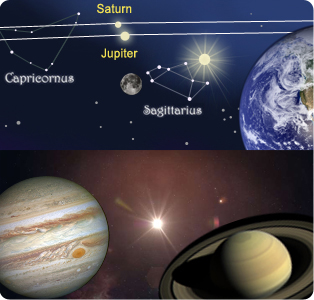
Jupiter – Saturn Great Conjunction on December Solstice is Poignant Symbol of Space Age
The 2 largest planets in the Solar System will align within 0.101° (1/5 of the diameter of a full Moon) of one another from geocentric point of view on December 21 – Winter Solstice in the Northern Hemisphere, Summer Solstice in the Southern. Human fascination with astronomical conjunctions, and specifically so-called Great Conjunctions of Jupiter and Saturn (the rarest of bright-planet conjunctions, owing to slow orbits) has a rich archeoastronomical history, perhaps most famously speculated as the “Christmas Star” in Biblical lore. While there was a closer Great Conjunction in 1623 (0.086°), no observation was recorded due to conditions. The most recently observed ‘Double Planet’ conjunction of the behemoth gas giants stretches back to 1226 and is thought to have influenced Genghis Khan to withdraw his armies from China. With modern technology, humanity has extended its reach to the farthest reaches of the Solar System, with Juno currently in orbit and Pioneer / Voyager missions conducting flybys of both giants, gaining momentum from gravity assist on the way to interstellar medium. This aspect of orbit mechanics has been described in detail by Serbian researcher Nataša Todorović in the just-released paper The arches of chaos in the Solar System, identifying outward manifold pathways through space generated by planets with dramatic effect on object speed. Notably, the upcoming Great Conjunction will be the first observed by humans living in Space. (Image Credits: NASA) |
Dec 21 — Firefly Aerospace, Launch Alpha Rocket, SLC-2 Vandenberg AFB CA: First launch attempt of Alpha rocket to reach space; launch window open through Jan 31, 2021.
Continued From…
TUESDAY
|
Dec 22 — The Space Show, Online / Tiburon CA: Dr. David Livingston talks with Ajay Kothari, President and Founder of Astrox Corporation of Washington DC.
Dec 22 — Ursid Meteor Shower Peak: Appearing to radiate from β star of Ursa Minor, Ursids are associated with comet 8P/Tuttle, they offer medium speed (33 km/sec), mostly faint with a few fireballs, ~15 per hour, visible in northern Hemisphere.
Dec 22 — Apollo Asteroid 2020 XH6: Near Earth Flyby (0.016 AU)
WEDNESDAY
Dec 23 — Moon: 5.1° SE of Mars, 14:00.
Dec 23 — Venus: 5.6° N of Antares, 11:00.
Dec 23 — Apollo Asteroid 2020 XJ3: Near Earth Flyby (0.013 AU)
THURSDAY
Dec 24 — Hubble Space Telescope, LEO: Spacecraft makes visible pass over Hawai’i starting 05:18:05 from SSW to 05:23:53 in E, magnitude 2.1.
Dec 24 — Moon: At apogee (distance 405,013.16 km), 07:00; 3.2° SE of Uranus, 16:00.
Dec 24 — Aten Asteroid 2011 CL50: Near Earth Flyby (0.003 AU)
FRIDAY
Dec 25 — Mars Express, Mars Orbit: ESA spacecraft reaches 17 full years / enters 18th year in Mars orbit today; will continue to study Mars atmosphere & climate, planet structure, mineralogy, geology, and search for traces of water; launched June 2, 2003.
Dec 25 — Aten Asteroid 501647 (2014 SD224): Near Earth Flyby (0.020 AU)
Dec 25 — Apollo Asteroid 2020 XY: Near Earth Flyby (0.040 AU)
SATURDAY
Dec 26 — Solar Orbiter, Heliocentric Orbit: Dedicated to solar and heliospheric physics, ESA Solar Orbiter to perform 1st Venus flyby today for gravity assist to reach its operational orbit (over next 3.5 years) with perihelion 0.28 AU and aphelion 0.91 AU; launched February 10, 2020.
Dec 26 — Moon: 5.8° SE of Pleiades 16:00.
Dec 26 — Apollo Asteroid 2018 XE4: Near Earth Flyby (0.014 AU)
Dec 26 — Aten Asteroid 2012 XE133: Near Earth Flyby (0.031 AU)
Dec 26 — Apollo Asteroid 2020 XT2: Near Earth Flyby (0.034 AU)
SUNDAY
Dec 27 — The Space Show, Online / Tiburon CA: Dr. David Livingston hosts open lines for call-in discussions.
Dec 27 — Moon: 4.6° N of Aldebaran, 10:00.
Dec 27 — Aten Asteroid 2016 AF2: Near Earth Flyby (0.019 AU)