Juno, Fermi, NuSTAR Upcoming Deep Space Observations and Encounters
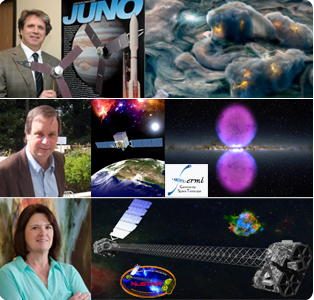
Jupiter explorer Juno is set for its 34th perijove and 33rd science flyby June 7 coming within 3,500 km of the gas giant cloud tops and 1,000-km of moon Ganymede. With the goals to collect data on the origin and evolution of Jupiter, search for solid planetary core, map magnetic field, measure water and ammonia and observe auroras – Juno will celebrate its 5th full year at Jupiter on July 4, and 10 years since launch August 5. Its mission extension until September 2025 will allow for 42 additional orbits of Jupiter, including close passes of Jupiter north polar cyclones, flybys of Ganymede, Europa, and Io. On June 11 Fermi Gamma-ray Telescope at ~550-km LEO will reach 13 full years / enter 14th year in space. Mapping the entire sky every 3 hours, Fermi provides data on gamma-ray bursts, black-hole jets, pulsars, supernova remnants, cosmic rays and dark matter. The mission is extended through 2022, and is credited with helping to confirm Milky Way Galaxy gamma- and x-ray emitting Fermi bubbles in 2010. Reaching 9 full years / entering 10th year of operations at ~605-km LEO, Nuclear Spectroscopic Telescope Array (NuSTAR) continues X-ray astronomy investigations of black holes, supernova remnants and active galaxies particle acceleration. Beginning June 1 and running for 1 year are 84 recently selected NuSTAR cycle 7 general observer proposals / targets. (Pictured T-B: Juno PI Scott Bolton; Fermi PI Peter Michelson; NuSTAR PI Fiona Harrison; Image Credits: SwRI, NASA, Caltech, JPL, CXC, SAO, MSSS, Gerald Eichstädt) |
MONDAY Highlights…
|
 Jun 7 — ISS, ~405-km LEO: Expedition 65 seven-member crew preparing for 2 USA EVAs starting next week, transferring cargo from Dragon CRS-22, Progress 75P, 77P and Cygnus NG-15; working with solid combustion experiment, setting up for cell / gravity studies, completing mood, nutrition and sleep surveys.
 = All times
for terrestrial events in local time unless noted.
 = All times for international terrestrial events in local time unless noted.
 = All times for space events, and…
 = All times for international space / astro events in Hawaii Standard Time unless noted. Add 10 hours to obtain UT (‘Universal Time’).
Weekly Planet Watch – Evening Planets: Venus (WNW), Mars (WNW), Jupiter (SE), Saturn (SE), Neptune (E).
2021 PTMSS / SRR Highlights New Frontiers in Mining and Global Perspectives
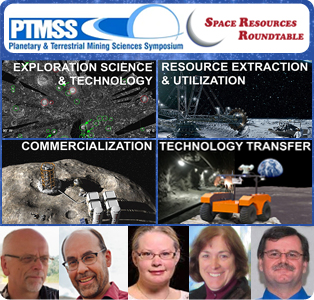
The 11th joint Planetary Terrestrial Mining Sciences Symposium and Space Resource Roundtable is being held online June 8-11. There are ~100 technical talks (including lightning talks), 3 roundtable discussions, and business-to-business meeting opportunities. Main topics fall under categories – The Moon: Enabling a sustainable presence; Mars: Identifying and extracting valuable resources; Asteroids: Sampling and Utilization; Space Manufacturing and Construction: Taking advantage of the space environment and planetary materials; Building the Infrastructure: Supplying power, communications, transportation and life support; and Space Commerce, Policy and Legal Issues, and International Efforts: A multi-dimensional endeavor. Opening Remarks will be given by (L-R) Dale Boucher of Deltion Innovations and Angel Abbud-Madrid of Colorado School of Mines. Other speakers include Director of Canadian Minerals and Metals Plan Secretariat Melanie Campbell, VP of Space Program Policy at Canadian Space Agency Mary Preville, and Gerald Sanders of NASA JSC. During the Commercialization Session, George Sowers will present on “Business Case for Lunar Ice Mining” and Christine Edwards on “Lockheed Martin’s Vision for the Lunar Water Economy”. Break sponsors are MDA, Interstellar Mining and WGM (Watts, Griffis and McOuat), and business-to-business meetings are hosted by Evocati Resources and Centre for Excellence in Mining Innovation. While Canada minerals production reached CA$48.2B in 2019, the potentially unlimited resources of Space would include volatiles, minerals, solar power, regolith and locations for unique science, astronomy, observation and communication. (Image Credits: PTMSS, SRR, CO School of Mines) |
 Jun 7 – Aug 13 — Lunar and Planetary Institute, Online and Houston TX: LPI Summer Internship for 2021. Jun 7 – Aug 13 — Lunar and Planetary Institute, Online and Houston TX: LPI Summer Internship for 2021.
Continued From…
TUESDAY
|
WEDNESDAY
Jun 9 — NASA, JPL, Caltech, Online / Pasadena CA: Teaching Space With NASA Live Stream – Tracking Asteroids; 15:00 PDT.
Jun 9 — Institute of Physics Atomic and Molecular Interactions & Molecular Physics Groups, Online / United Kingdom: Lecture: Planetary Atmospheres – From Earth and Beyond.
Jun 9 — Moon: 5.4° N of Aldebaran, 05:00.
Jun 9 — Mercury: At aphelion, 0.4667 AU from Sun, 15:00.
THURSDAY
Jun 10 — National Science Foundation, Online / Alexandria VA: Online: Arecibo Observatory Options Workshop ‘Divergent Thinking’.
Jun 10-12 — China Global Television Network (CGTN), China Association for Science and Technology, Beijing, China and Online: 2021 Global Forum on Communication in Science.
Jun 10 — Moon: New Moon, 00:53; 3.9° N of Mercury, 03:00.
Jun 10 — Annular Solar Eclipse: Total eclipse visible from parts of Russia, Greenland and northern Canada; partial eclipse seen from North Asia, Europe and USA; maximum eclipse at 10:41:54.
FRIDAY
Jun 11 — Fermi Gamma-ray Telescope, LEO: Spacecraft with Large Area Telescope & Gamma-ray Burst Monitor instruments reaches 13 full years / enters 14th year in Space; launched 2008.
Jun 11 — Moon: 1.10° NNE of M35 cluster, 03:00; 1.51° NNE of Venus, 22:00.
Jun 11 — Apollo Asteroid 2021 KZ2: Near-Earth Flyby (0.031 AU)
SATURDAY
Jun 12 — AIAA Los Angeles / Las Vegas Section, Online: Aerospace Projects in India: Recent Developments and Future Plans; by Prof. Rajkumar S. Pant, Aerospace Engineer from Indian Institute of Technology.
Jun 12 — Moon: 6.7° S of Castor, 16:00; 3.1° S of Pollux, 21:00.
Jun 12 — Venus: At perihelion, 0.7184 AU from Sun, 08:00.
Jun 12 — Apollo Asteroid 2021 JM6: Near-Earth Flyby (0.028 AU)
SUNDAY
Jun 13 — Nuclear Spectroscopic Telescope Array (NuSTAR), LEO: NASA satellite reaches 9 full years / enters 10th year of operations in space today; launched 2012.
Jun 13 — Moon: 2.79° NNE of Mars, 12:00; 3.1° NNE of Beehive Cluster, 23:00.